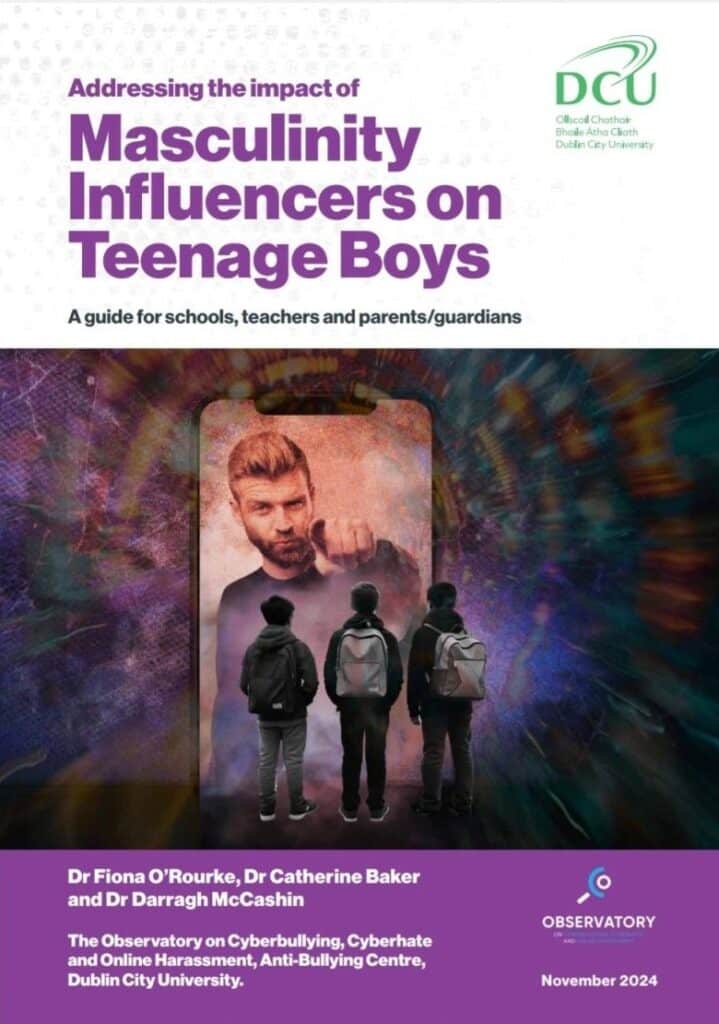
In schools across Ireland, teachers and parents are noticing a real shift: many teenage boys are now engaging with online figures who present themselves as role models of “strength,” “success,” and “real masculinity.” While some of this content may seem motivational or harmless at first glance, research shows that a portion of these masculinity influencers promote rigid, oppressive, and harmful ideas about manhood, often linked to sexist, misogynistic, homophobic, or emotionally restrictive beliefs.
These messages don’t just stay online. They can affect how boys perceive girls, how they treat women teachers, and even how they relate to themselves and their peers. Some boys begin repeating discriminatory language, adopting aggressive attitudes, or withdrawing emotionally because they’ve absorbed the idea that expressing vulnerability is “weak” or “unmanly.”
Why some boys are drawn to these influencers
The guideline published by Dublin City University’s Anti-Bullying Centre reminds us that teenage boys today are facing real challenges:
- mental health pressures
- social anxiety and isolation
- economic uncertainty about jobs and the future
- changing gender roles
Many of them feel that society is focusing more on girls’ and women’s empowerment, and they fear boys’ issues aren’t being acknowledged. This creates a vulnerability that harmful influencers exploit. They offer simplistic answers (“man up,” “get rich,” “dominate”), while ignoring the deeper social and emotional realities boys are balancing.
Respectful engagement – not shaming or lecturing
A key message from the guideline is that teenage boys must not be spoken down to, blamed, or stereotyped. Not all boys agree with these influencers. Many already critique or reject their messages. For others, this may be the first time they’re thinking deeply about masculinity at all.
That’s why adults should approach conversations with curiosity, empathy and respect, not condemnation. Boys should feel they can ask questions, express uncertainty and disagree openly. Conversations must be “with them, not at them.”
Practical ways to support boys
- Promote emotional openness
Help boys see that courage and vulnerability can co-exist. Being strong includes asking for help when needed. Emotional literacy is a strength, not a weakness.
- Encourage critical thinking about online content
Rather than saying “That influencer is bad,” ask:
- What do you think he’s trying to achieve?
- Who benefits from his messages?
- Does this content reflect your values?
This builds agency. Boys learn to analyse, not just absorb.
- Create space for boys to talk about masculinity
For many boys, no one has ever asked: “What kind of man do you want to be?”
Encouraging reflection on values, such as loyalty, integrity and kindness, supports boys in building a positive masculine identity.
- Invest in positive role models
The guideline stresses that boys with healthy interpersonal environments, such as supportive teachers, coaches, older peers, family figures, are less likely to gravitate toward harmful influences.
Building respectful, equitable relationships
Ultimately, this isn’t just about preventing harmful behaviour. It’s about helping boys develop healthy, respectful, and equitable relationships, now and as they become adults. The aim is not to attack masculinity, but to broaden it to make space for emotional honesty, compassion, respect and equality.
A shared responsibility
This guidance makes it clear: addressing the influence of harmful online masculinity influencers is not just the job of parents, or teachers, or digital platforms. It requires a societal effort by building a culture that challenges harmful stereotypes, supports healthy development, and gives teenagers the tools to navigate online spaces safely and thoughtfully.
Endnote:
The referenced guideline is the output of a research project at the Observatory on Cyberbullying, Cyberhate & Online Harassment, Anti-Bullying Centre, Dublin City University, Ireland, which was funded by the Department of Justice:
O’Rourke, F., Baker, C., & McCashin, D. (2024). Addressing the impact of Masculinity Influencers on Teenage Boys. A guide for schools, teachers and parents/guardians. Anti-Bullying Centre, Dublin City University. doi: 10.5281/zenodo.14102915